Tuesday, 4 November 2014

Genesis of an Icon


Astrup Fearnley Museum of Modern Art 
Oslo 2012
Renzo Piano Building Studio with Narud-Stokk-Wiig (Oslo)


Renzo sipped his digestivo ruminatively. It had been another good lunch. Smoothing his napkin, he outlined the concept for the new Astrup Fearnley Museum with a few expressive strokes of his pen. Another signature design for an institution in search of an icon. When he got back to the office he would pass it to his team of assistants drawn from the best Swiss and German universities...

Prominently located on the former shipyard site of Tjuvholmen and overlooking Oslo Fjord, Renzo Piano's Astrup Fearnley Museum of Modern Art is a striking design, but one that raises more questions than answers. A grandly curved roof profile unifies the composition, which is bisected by a narrow pedestrian street and canal, lending it a distinctive identity, particularly when seen from the water. The street is an extension of the adjacent waterfront promenade and connected to it by a bridge across a canal. It terminates in framed views across the fjord. To one side, a wide flight of steps leads up to a picturesque jumble of timber houses strung out along steep and narrow streets. A scrap of grass separates the other side of the museum from the water. A small, newly created, swimming beach provided with showers is one of the best features of the project, although its scale and character feel curiously inadequate in the context of the city, fjord and large museum.

From a range of anything less than 200m, this project appears even more riven by misjudgements. The big roof is the defining feature of the building, but its asymmetrical form suggests uncertainty: it neither belongs to the orthogonal forms of the city backdrop or contrasts with it in any satisfying way; the curved roof covers a series of smaller spaces, creating awkward volumes in the meanly proportioned galleries; the divisions of the block create a visual weakness where the roof straddles these. The separation of the temporary and permanent exhibition spaces by the street makes no sense whatsoever, merely introducing another dislocation in the already fragmented experience of the museum.

The permanent exhibition gallery is awkwardly arranged half a level down from the entrance, so that passing pedestrians and cyclists create a distracting visual disturbance above the art display. Although Jeff Koons sculptures and ranks of Damien Hirst vitrines could probably hold their own in any environment, the distracting reflection off the glass on a magnificent Francis Bacon triptych, poorly placed next to a large window, make it difficult to enjoy the painting. And all of this in a building over half of which appears to have been dedicated to commercial development.


Tuesday, 21 October 2014

Gol Stave Church


Gol Stave Church  1212
Norwegian Museum of Cultural History, Oslo

Norway's medieval stave churches connect us with primordial qualities of architecture

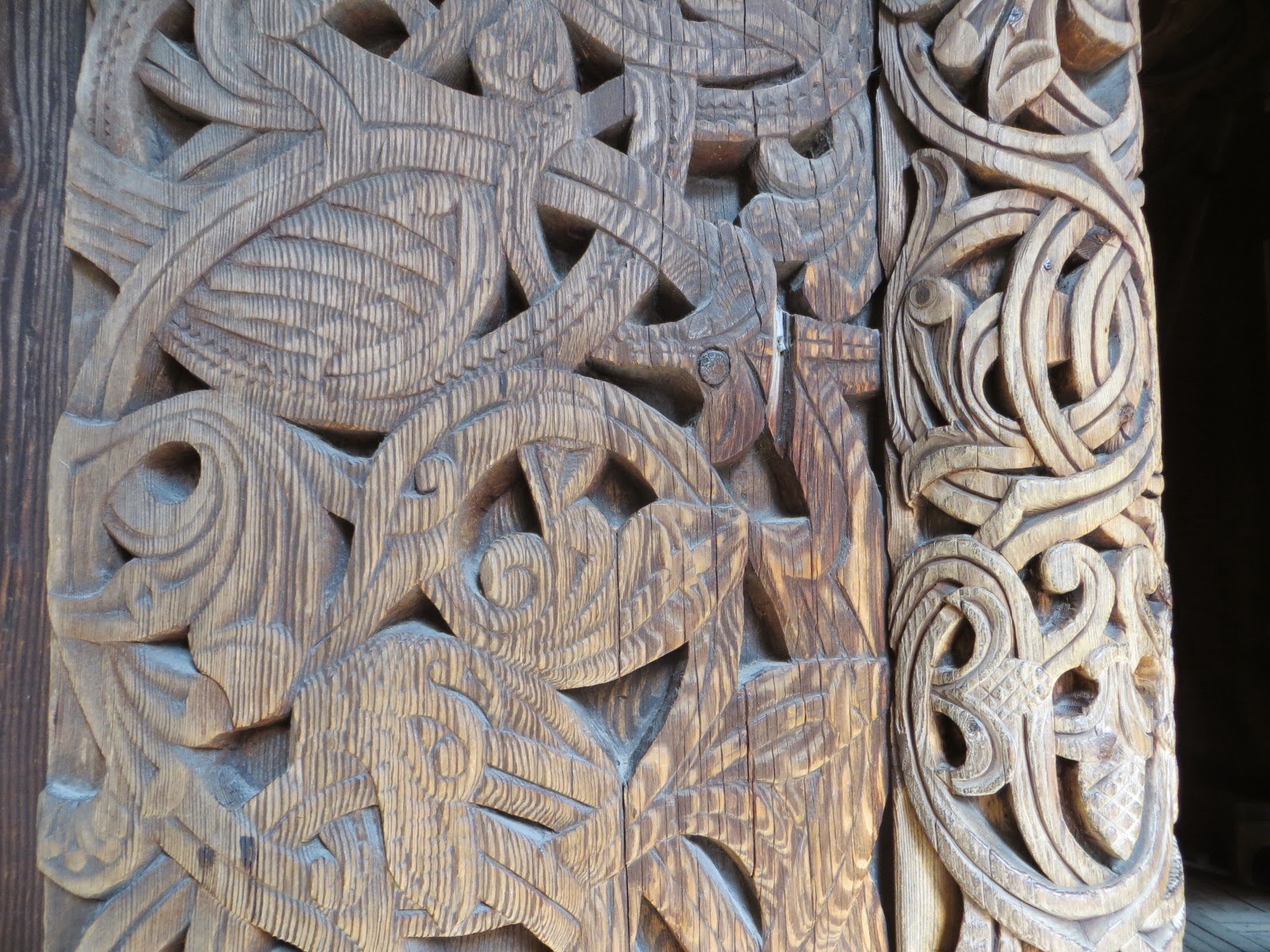
A deeply satisfying scent of timber with a hint of tar greets you when you enter the 800 year old Gol Stave Church relocated to the Norwegian Museum of Cultural History. Smell is not a sense often associated with architecture although, for anyone who spends time on building sites, excavation, concrete, timber and plaster all have distinctive odours, redolent of the different stages of construction. On completion these may be replaced with the quickly fading smell of carpet and fresh paint, making the persistent scent of the stave church after nearly a thousand years all the more extraordinary. These elemental enclosures have a well-tempered physical ambience.

The Museum of Cultural History in Oslo consists of a remarkable collection of reconstructed buildings, the most interesting of which, for me, were those built in timber. Even today, human settlement in Norway feels as though it has been hacked out of the forest. The abundance of timber encouraged the development of remarkable carpentry skills, expressed most eloquently in the sophisticated Viking craft built in the 8-11th centuries and in the medieval period by a few hundred stave churches. The word stave derives from the Old Norse 'stafr', meaning post, and the stave churches are built exclusively in timber suspended above the ground on boulder footings.

Joints have evolved so that vulnerable grain is protected by a the next layer of construction. Building with just one material, timber, invests the buildings with a powerfully unified aesthetic. The construction logic of these ritual shelters generates compelling form and scale, which is adorned with dragon roof finials and some relief carving on structural elements. Curiously, the circular section free-standing timber posts have a slightly self-conscious architectural quality, perhaps alluding to stone columns in churches seen outside Norway.

The principle source of daylight is from door openings, and strong side-light penetrating the interior gloom creates a dramatic chiaroscuro effect rare in western architecture. Details are lost in the shadows of its warmly hued interior. Darkness and the absence of light can be as powerful as metaphors for our spiritual or existential condition as brilliant illumination.

Sadly a few of the surviving stave churches, were lost to an arson campaign in the 1980's by black metal music devotees, who objected to the occupation of pagan sacred sites by Christian edifices. As a result, the church at Fantoft, near Bergen, reconstructed in 1992 following destruction by an arsonist is now surrounded by a wire security fence, which protects the building but wrecks its setting. Like the church in the Folk museum, it was moved from its original rural site at the end of the 19th century, demonstrating another advantage of timber: its capacity for re-cycling.


Thursday, 18 September 2014

Nordic Drama

Norwegian National Opera and Ballet, Oslo

Snohetta 2000-2008


In the spirit of Greek theatre, Snohetta's Opera House gives expression to the relationship between nature and society

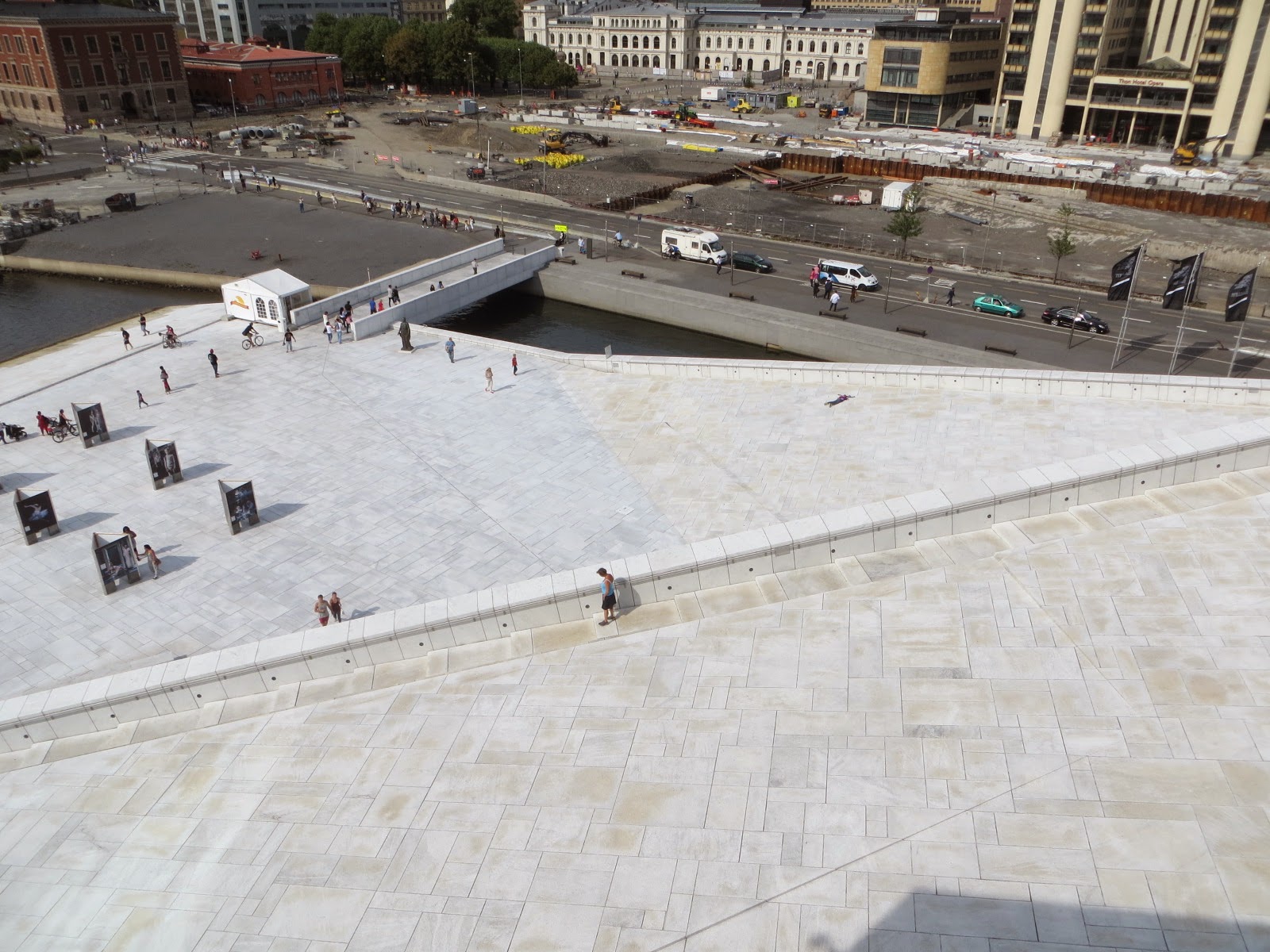
It is rare for a building to exert an appeal as compelling as that of Snohetta Architect's competition-winning Oslo Opera House. An inclined white marble pavement forms the roof, tilting spectacularly down to the water of Oslo Fjord. The glazed box-like enclosure of the foyer projects through the roof planes, asserting the presence of the internal volumes. Within this glacially cool exterior, the drum-shaped auditorium is clad in a textured arrangement of oak slats that generates an inviting sense of warmth.

An expansive open-air promenade connects fjord and street level with the roof-top, creating an exciting urban topography that encourages casual use, whether to enjoy the spectacle of everyday life and the city, or for occasional performances of dance or music. Snohetta manage this without 'burying' the Opera House: although its canted roof can be enjoyed without reference to the elite cultural activity of the interior, the primary function of the building is not suppressed. A strength of the layout is the clear definition of a single public entrance facing the city across a small bridge. Once inside, the lofty cubic volume of the foyer encloses the drum shape of the auditorium. Opposite the entrance is a cafe opening onto a terrace flanking the fjord. The privileged urban arena above the Opera House acts as an extension to the public realm of the city into its natural setting, mediating between orthogonal forms and organic ones, an invocation of the mythic Norwegian landscape of fjord and glacier.

More surprises fill the interior: like the raking, asymmetrically placed columns and filigree backlit screens enclosing toilets, but these always function within a coherent whole. The screens are designed by Olafur Eliasson, a commission won in competition, and one of several collaborations with artists that have been successfully integrated into the architecture. The rich colour and texture of the auditorium's rounded form at the heart of the building contrast with the surrounding cool white surfaces of the foyer.

The Opera House is a consummate achievement, negotiating a balance between comprehensible form and finely wrought abstract details: it is accessible without being condescending; the public space of this man-made glacier has an unforced theatricality, connecting the city with its topography.


See May 2012 post on the Millennium Centre, home of Welsh National Opera 

Saturday, 24 May 2014

Finding a Connection for the Noble Savage


Bibliotheque Nationale de France Francois Mitterand, Paris

Dominique Perrault 1996


'I am as free as nature first made man,
Ere the first base laws of servitude began,
When wild in woods the noble savage ran.'
John Dryden 'The Conquest of Granada' 1672


The 'wild’ wood at the heart of Dominique Perrault's Bibliotheque Nationale evokes Enlightenment concepts of the human spirit, but is this monumental shrine to the cult of the book anachronistic in a digital age?

It sometimes seems as though millennia of paper-based literary culture have been rendered anomalous in the space of a few years by the advent of digital media. Even when Dominique Perrault's Bibliotheque Nationale building was completed in 1996, the notion of a book was endowed with physicality, that has since been shed with astonishing alacrity. If the book as physical entity is heading for obsolescence, where does that leave the library as a building type?

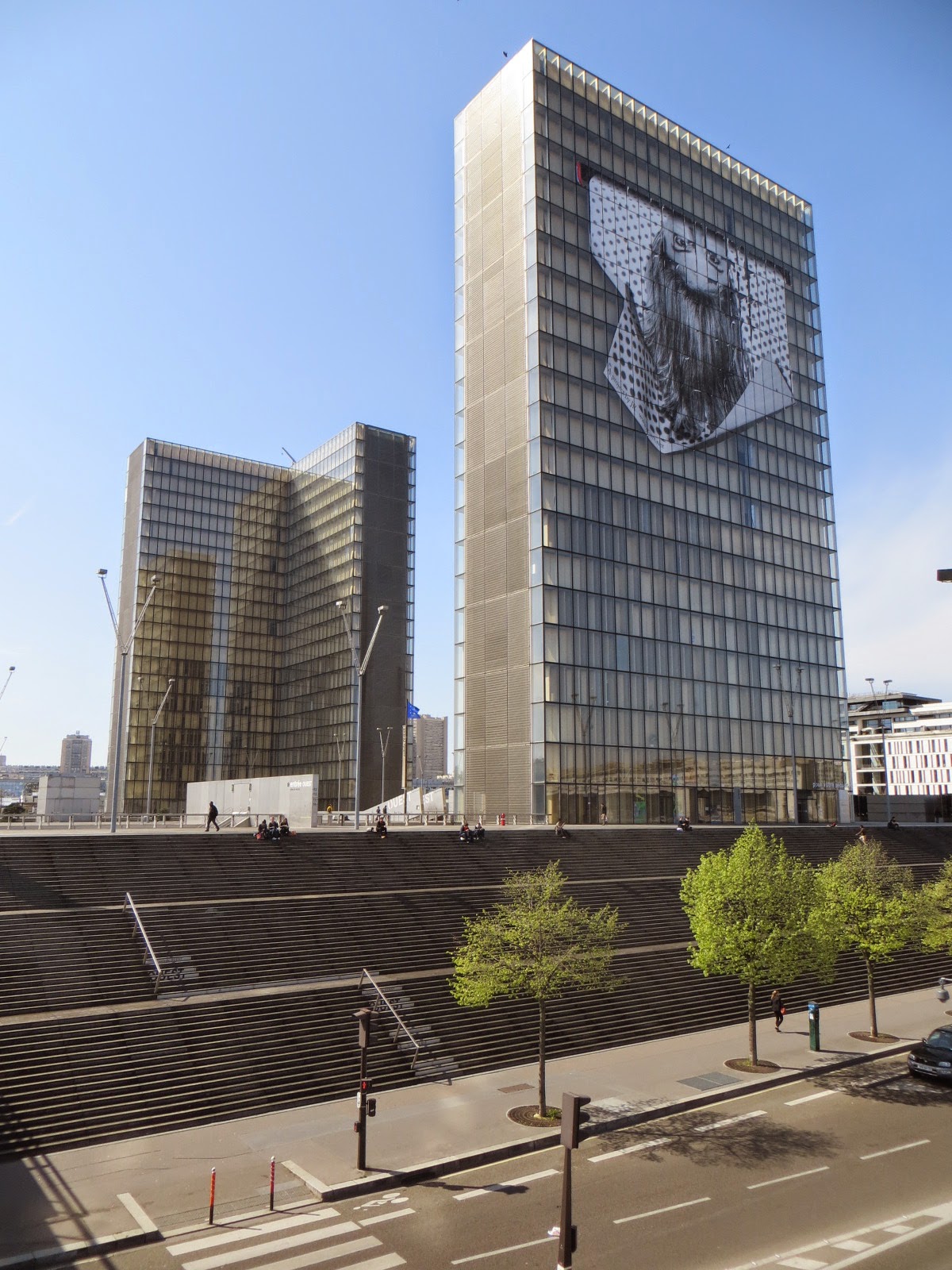
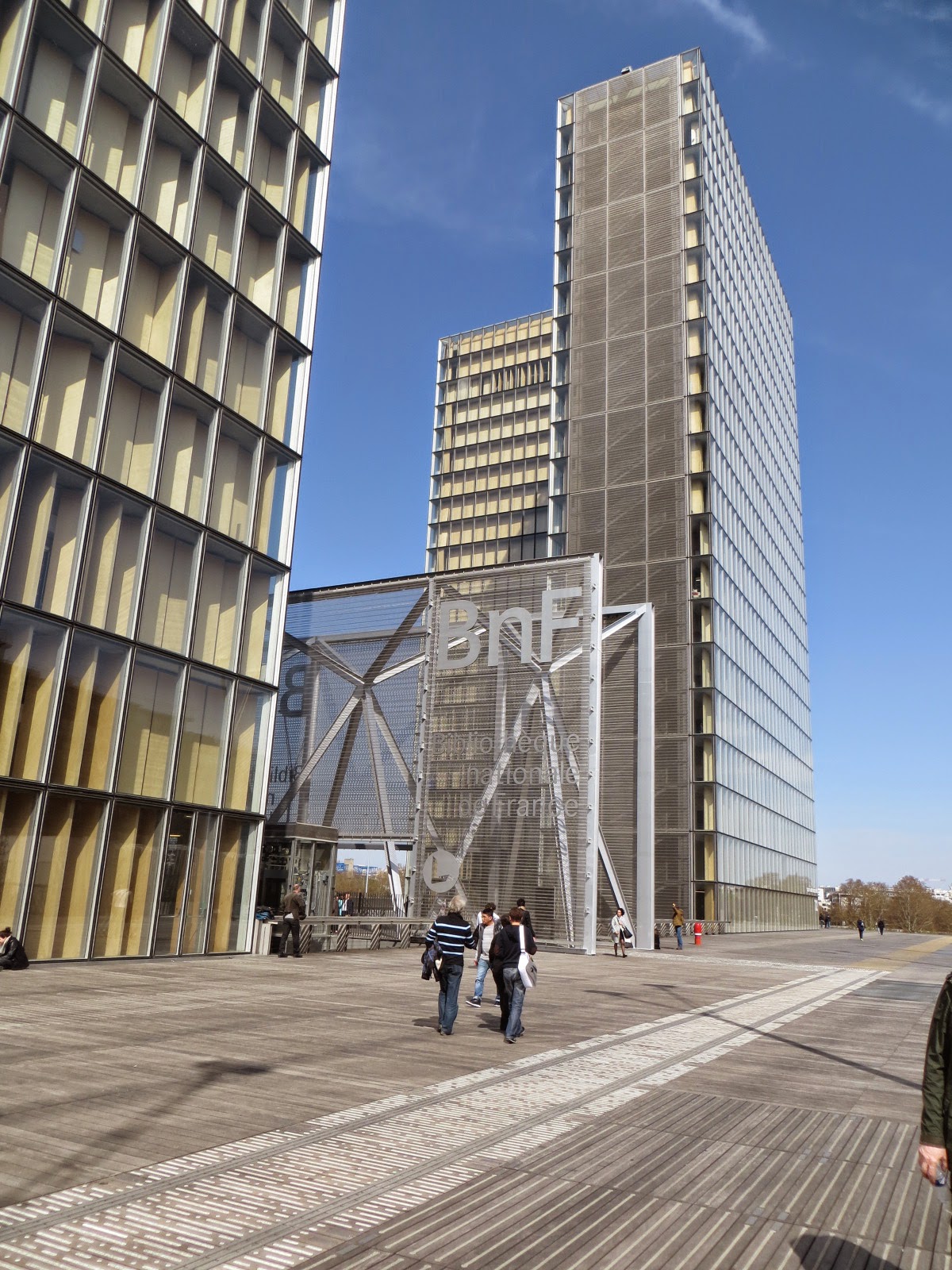
The Bibliotheque Nationale is no ordinary library however, but a building of visionary ambition in the grand French tradition. This monumental pile, defined by corner towers of book stacks, is more than a building, it is an ordered fragment of an ideal city, upholding the Enlightenment vision epitomised in Boullee's Bibliotheque du Roi (1785). The reading rooms are arranged around a courtyard packed with a 'wild' wood, invoking Dryden's 'Noble Savage', a seductive origin myth for western culture often associated with Rousseau, ideologue of the French Revolution.

Ambitious links have been created between the library and its environs, including a new park on the facing bank of the adjacent Seine. A sinuous pedestrian bridge delivers visitors at the level of the entrance court on the roof of the library, but this is high above the park and the banks of the river. The inflated scale of the buildings and stepped embankment enclosing the park create a claustrophobic quality. Although the library terrace overlooking the woodland garden is open to the public, the generosity of this gesture is undermined by the intimidating barrier created by significant level changes. Access from this level back down to a library entrance within the court is clumsily handled. Nonetheless, turning conventions about levels and arrival on their head at the Bibliotheque creates wonderfully unexpected moments. The corner book stacks might defy logic, but they give the building great presence in the city and provide a point of reference for the new quarter developing in this former industrial hinterland.

Digital communication enables us to enjoy Rousseau on the Metro or in the park: it offers new opportunities to gain access to books and form associations unbound by geographical location, but cities allow the congenial association of people in many different activities. Surely enjoying access to the collections of great libraries will continue to be one of these.


See previous blog on Max Dudler's Humboldt University Library Berlin (2006-2009)

Bibliotheque du Roi, Etienne-Louis Boullee (1785)


Wednesday, 26 March 2014

Sensing Spaces


Sensing Spaces

Architecture Reimagined


Royal Academy of Arts

'Sensing Spaces - Architecture Reimagined', an exhibition at the Royal Academy, successfully engages its audience and raises questions about how the experience of architecture can be communicated

Can architecture be adequately represented in an exhibition, or any other medium? Buildings are generally unique, fixed in place, and we must therefore often experience them through other media. Photography can be a beguiling proxy for the real thing, but what makes a good photo is not the same as what makes a good building. Even before the advent of photography, Palladio used I Quattro Libri to promulgate an idealized representation of his buildings. The Emperor Hadrian built copies of exemplary projects he had seen on trips to far flung corners of the Roman Empire in the grounds of his villa at Tivoli. Stripped of context and use, they become something new altogether.

International expositions, in which participating nations commission pavilions, are also exhibitions of architecture. The International Exposition of Modern Industrial and Decorative Arts in Paris in 1925 memorably introduced pivotal projects of the early modern period: Le Corbusier's Esprit Nouveau pavilion and the Melnikov pavilion for the Soviet Union. Building exhibitions can have a longer physical legacy. The Weissenhof Estate, built for the 1927 Deutscher Werkbund Exhibition in Stuttgart, survives as a corner of the city containing canonical works by Le Corbusier, Mies van der Rohe, Gropius and Scharoun. The International Building Exhibition in Berlin (1979-87) was the catalyst for influential projects by Rossi, Gregotti, Rob Krier, Siza and Eisenman.

More recently, at the Serpentine Gallery in Kensington Gardens, the construction of a temporary pavilion each summer has provided a platform for international starchitects to put on bravura displays of creativity. The interest of this endeavour has been to see how successive designers respond to the same programme, as well as to the efforts of their predecessors. Here enlightened patronage licenses the participants to explore their obsessions without regard to the usual constraints of permanent construction. Although this process is limited, it is also liberating, inspiring an annual celebration of architectural ideas.

Sensing Spaces - Architecture Reimagined, the current Royal Academy exhibition, presents a bold and well conceived answer to the question: 'How do you represent architecture?'. Six architects were invited to construct installations in the main galleries of the Academy. A strength of the show is that it allows the visitor to experience the space and materiality of each installation directly for themselves, rather than through another medium such as photos or drawings.  Artful juxtaposition highlights the contrasting approaches of the different architects.

Pezo von Ellrichshausen have created an enigmatic tower structure, located at one end of a grand gallery, that conceals its interior spaces and occupants. Tight ramps and stairs open onto privileged views of details high up in the interior. Siza and Souto de Moura both invoke a connection with architectural history and express the need to respond to it in ways which exploit contemporary culture and construction. Siza's elemental concrete columns in the Academy forecourt are ambiguously suggestive, but of construction or ruin? Souto de Moura's displaced classical door linings, formed from thin concrete, initially appear to be precise copies of the originals in the Academy but, on closer inspection, they have been subtly simplified. They neatly focus attention on the form and construction of the thresholds between the galleries in the Academy. Grafton Architects have built a top-lit assembly of suspended sculptural beams in adjacent spaces. A rough white plaster finish used in the brightly lit space contrasts with a darker, heavier, effect in which the beams have a simulated concrete finish. A wrinkle in the light-weight facing betrays a weakness in their approach: you realize that the construction is not really concrete and this negates the frisson that would come from real weight. Kengo Kuma chose a space that lacked daylight. Although his delicate filigree structure of bamboo canes is dramatically uplit and the background of the room shrouded in darkness, it would be a mistake to think that this installation was conceived as within a black box, for it surely alludes to the Japanese understanding of darkness, in contrast to a Western preoccupation with light. Li Xiaodong's labyrinthine installation gains power from the juxtaposition of walls formed from arrays of short log posts and smooth ply linings. However, the undeniable crowd pleaser is Diebedo Francis Kere's improvised tunnel, formed from small pieces of plastic honeycomb fixed with cable ties and adorned with an increasingly shaggy coat of coloured plastic straws added by visitors. His polemical installation questions the role of the architect as auteur and the notion of aesthetically complete construction: participation and organic development are put forward as alternatives, challenging the more conventional professional assumptions of other participants in the exhibition.

Like architecture outside the gallery, the installations in Sensing Spaces are subject to the ebb and flow of light and human activity, successfully conveying its inherent dramatic and sculptural qualities.  Even if the gallery context dilutes the experience, this exhibition eloquently demonstrates some of the complex and elusive factors that contribute to our experience of architecture.

Sensing Spaces - Architecture Reimagined 
Royal Academy of Arts (finishes 6 April 2014)


Tuesday, 31 December 2013

Ghent Stadshal: in praise of a building 'without use'


“’...a building without use.’...freed from ephemeral conditions and without an explicit function...the degree of usefulness is not a means to discriminate the art.”
Auguste Perret 1


Stadshal and Central Squares, Ghent (1996-2013)

Robbrecht en Daem Architecten and Marie-Jose Van Hee Architecten

When urban blocks around the Belfry, St Nicholas's Church and St Bavo's Cathedral in the medieval heart of Ghent were cleared before the First World War, some facades were salvaged and re-built on the Graslei harbour front, where they would reinforce the picturesque image of the city's mercantile origins. The hole in the city fabric left by this destruction was eventually occupied by a car park. Following decades of lobbying and two architectural competitions, the architects Robbrecht en Daem and Marie-Jose Van Hee have recently completed their winning scheme: a free-standing building with an extensive undercroft and remodelled public space.

Officially known as the Stadshal, or City Hall, the free-standing building is intended for use as a venue for performance and markets. On the architects' websites it is given the less grand title 'Market Hall', although locally it also goes by the nickname of the 'Schaapstal’, or sheep pen. Does this uncertainty surrounding the name of the building reflect a deeper insecurity regarding its identity? Evidence on the ground and a search of images online suggest occasional use of the building for performances, but little other public activity. Clearly the use of any building is dependent on the energy and vision of the client and cannot be dictated by the architect. The Stadshal may be a building that is under-used, but even so, perhaps it fulfils a purpose that goes beyond the provision of accommodation for a specific activity?

Its enigmatic beauty is captured in a video on Robbrecht en Daem's website, in which snow flurries swirl through the space as hunched figures hurry by. An open-sided hall that sits at the centre of the city, the building articulates the space between the monumental Gothic towers of St Nicholas's Church and the Belfry, defining two small paved squares and a garden. These finely calibrated spaces recall the intimacy of the medieval layout. Although grand in scale, the Market Hall relates to the height of adjacent street facades, rather than competing with the neighbouring towers.

A distorted barn that eschews conventional expectations of form and construction, the timber boarded superstructure comprises a pair of asymmetrical parallel pitched roofs supported on four massive concrete piers. These house stairs and lifts down to the undercroft, a public hearth for fires and a large extract duct. The twin gables at each end are under-cut by a single pitched profile. The asymmetrical composition is subtly twisted. An irregular grid of small rectangular openings is cut into the roof, disrupting the scale of the building, especially at night: like an image from a sci-fi movie, it resembles a vast spaceship hovering above the ground. Nearby, a huge bell suspended inside a sculptural concrete cube adds a further surreal note.

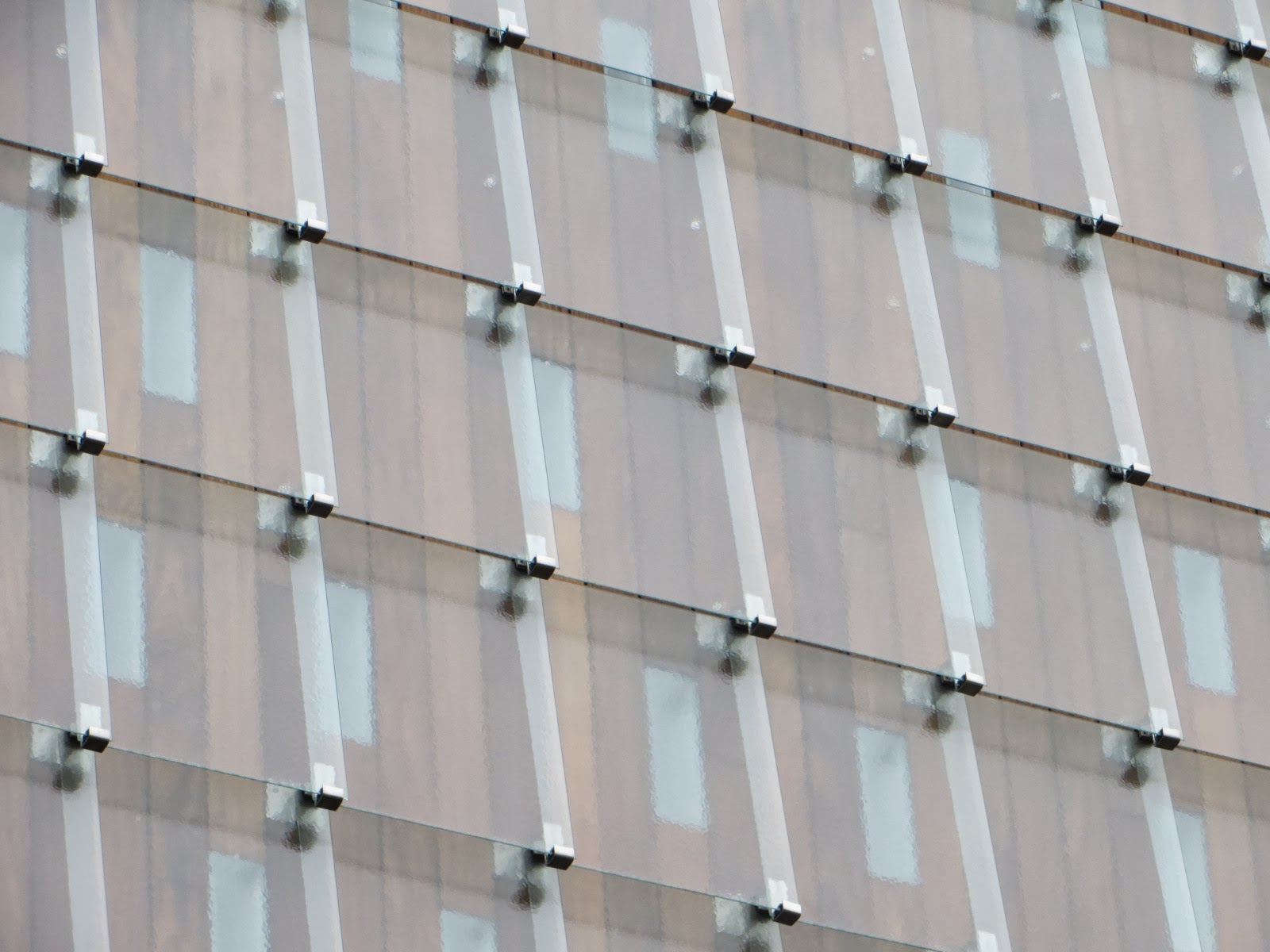
Overlapping glass shingles wrap the roof in an elegant deconstruction of traditional building techniques. Chinks of light are admitted into the hall through the tiny openings in the timber superstructure, evoking the quality of a ruined building. Constantly shifting in appearance, the glass shingles give the Market Hall a quicksilver character, responsive to the Northern European light and climate.

The extensive undercroft beneath the paved square is densely packed with accommodation: public bike storage, toilets and a brasserie. It is cut back on one side, forming a plinth for the Market Hall above. The Brasserie overlooks an informal garden at the lower level, with an undulating lawn and winding paths. The organic forms of this garden sit less comfortably with the surrounding city and adjacent Gothic monuments than the formal paved space around the Market Hall. However, at a strategic level, the change of level and contrasting character of the garden successfully establish a new order in place of the previously undifferentiated terrain of the site, creating a richer urban environment. Integration of highway engineering and tram lines in the street next to the garden are low key but significant achievements.

The discretion exercised by the architects of the Market Hall and its sensitive integration within the urban fabric disqualify this project from 'icon' status. Even without a fire burning in the public hearth or the bustle of street trade, the Market Hall and sensitive repair of the surrounding urban environment are a resounding success. When he extolled the virtues of a building 'without use', Auguste Perret recognised the truth that architecture may have value which transcends practical function.

1.  Auguste Perret, 'Collective Needs and Architecture', in The Rationalist Reader, Architecture and Rationalism in Western Europe 1920-1940 / 1960-1990, ed. by Andrew Peckham and Torsten Schmiedeknecht (London and New York: Routledge, 2014), pp.75-76 (pp.75-76).